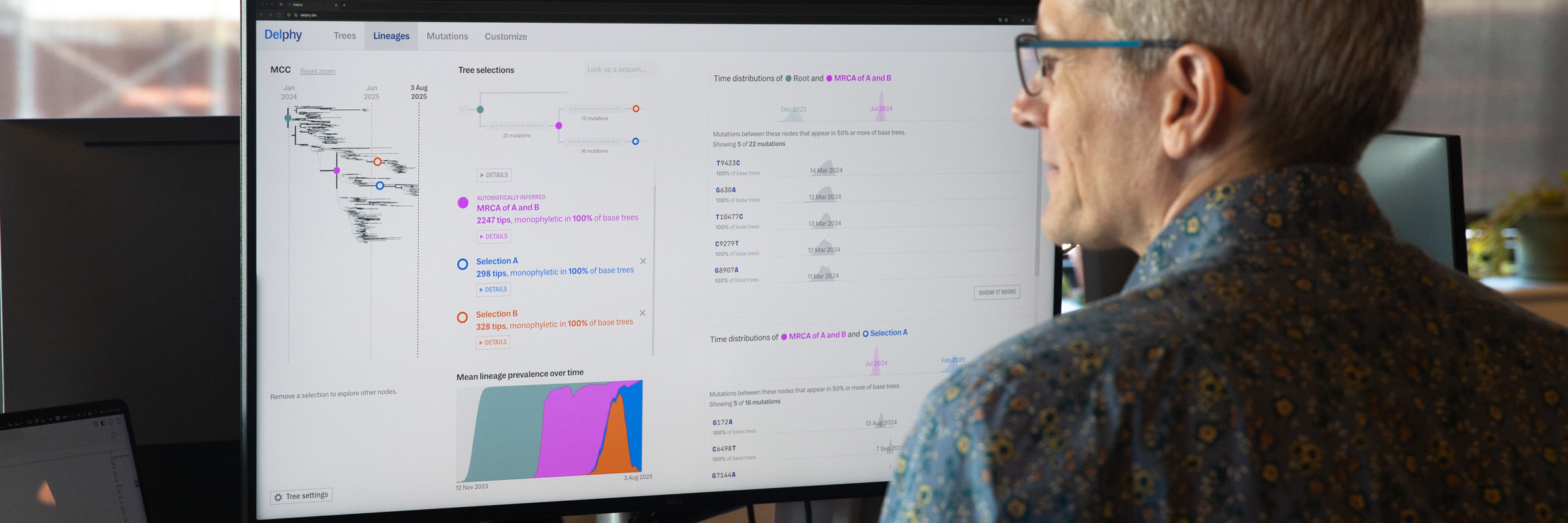
If you’ve been following our work, you may have seen our progress over the last few years developing Delphy into a fast, secure, and accessible browser tool for outbreak reconstruction. While Delphy is already publicly available and being used by our partners on the ground to combat active outbreaks, publication in Nature is a huge milestone for us as it allows Delphy to reach a whole new audience of researchers and public health workers.
Sequencing data is a critical source of information when it comes to understanding how a pathogen spreads and evolves over time. We built Delphy to remove as many barriers to entry for phylogenetics as possible. Where existing tools for Bayesian phylogenetic inference take considerable time, resources, and training to run, Delphy’s incredibly fast and powerful core, developed by the one and only Patrick Varilly, can generate trees that are ready to analyze in minutes (rather than hours or days) and entirely within the browser.
Having a web interface where you can monitor your run’s progress and immediately start interacting with your data is a game changer for this type of work. Not all epidemiologists and public health workers have the programming experience to run complex command line queries, but they do need to be able to work directly with sequencing data to better understand things like: what mutations are happening when? How prevalent are different variants and in which regions? How certain can we even be about these findings?
Delphy doesn’t require users to know any code or to have access to any specialized equipment. All it takes to get started with Delphy is a FASTA or MAPLE file and an internet connection. As soon as results stabilize, a significant level of analysis can take place within the tool itself. After uploading a file, users can dive right into lineage and mutation explorations and start finding patterns and asking questions about their data.
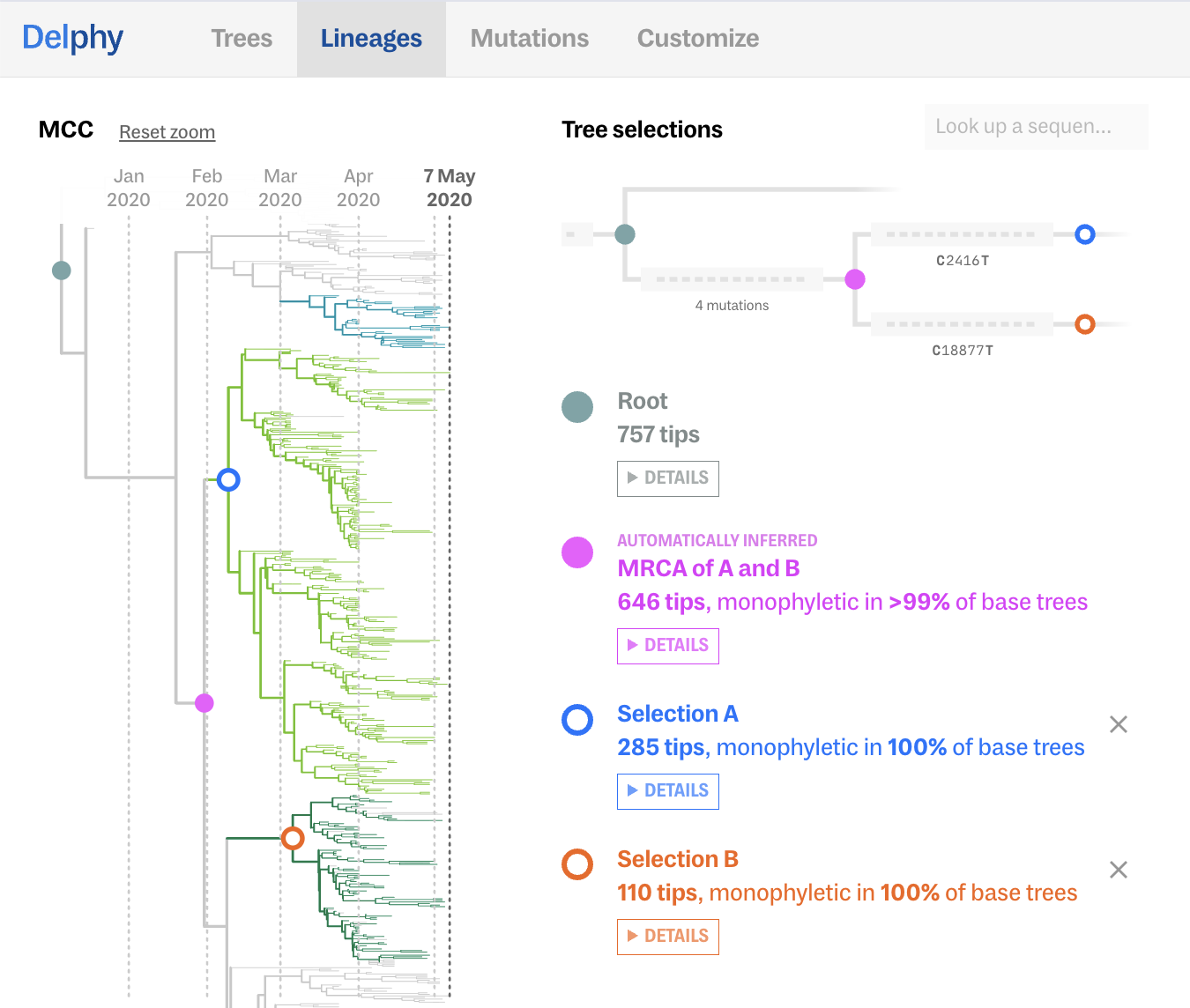
Early detection and rapid response are crucial to outbreak prevention, making fast and accessible tools essential for response work. For teams who need immediate insight into their sequencing data, Delphy provides a way to get those answers within minutes.
Delphy is one component of a broader effort to establish a framework for comprehensive outbreak surveillance and response called Sentinel that we’ve been developing alongside the Sabeti Lab of the Broad Institute of MIT and Harvard for the last seven years. Delphy is just one piece of this puzzle, and we look forward to sharing more of what we’ve been up to on this front in the weeks to come.
It’s exciting to have a project we’ve been working on for the better part of five years reach this incredible achievement, and we can’t wait to see Delphy in the hands of the broader scientific community.
We’d love to hear what you’re working on, what you’re curious about, and what messy data problems we can help you solve. Drop us a line at hello@fathom.info, or you can subscribe to our newsletter for updates.